
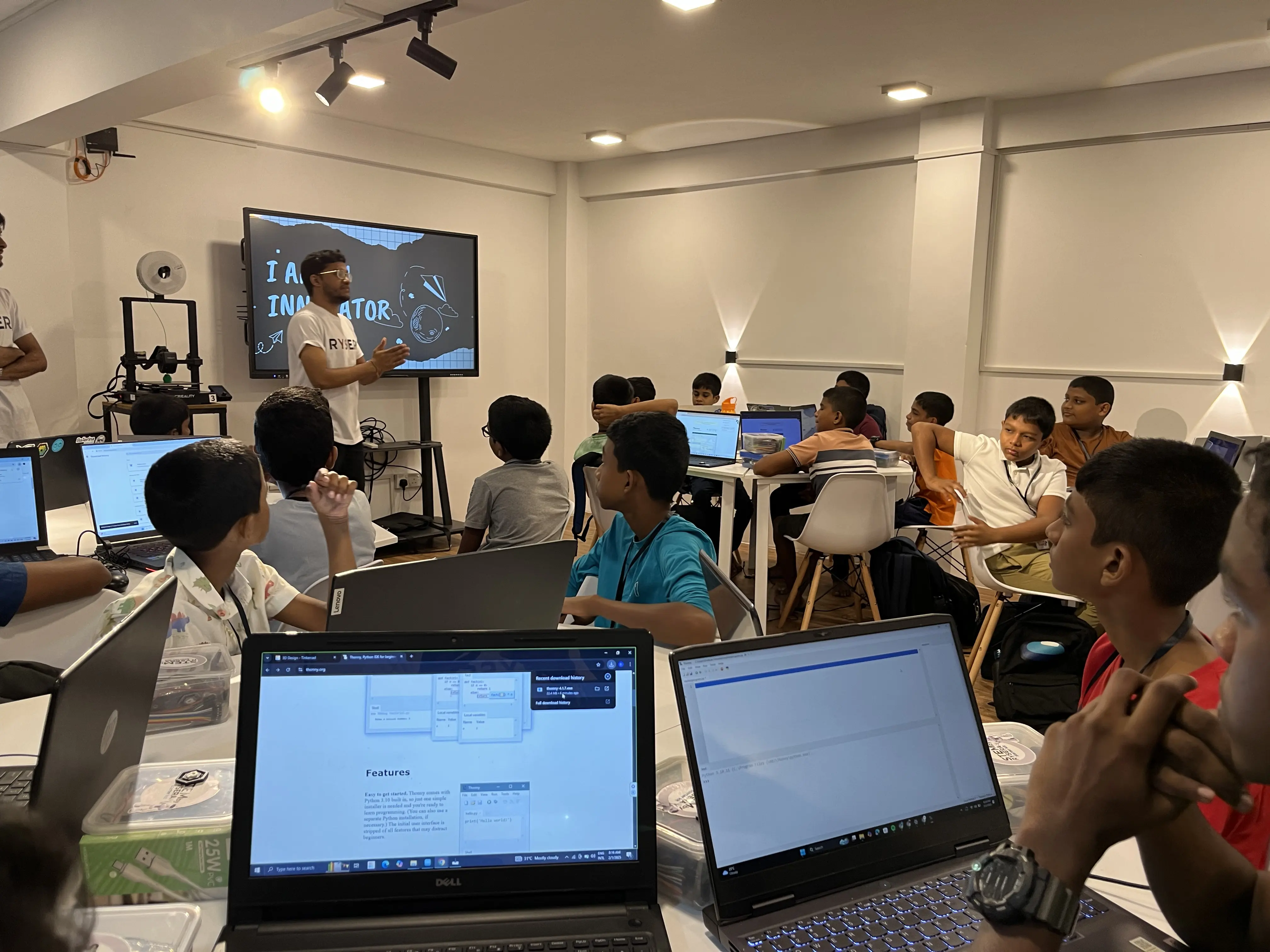
Sri Lanka has never had a shortage of talent. Walk into any school in the country and you'll find students who are curious, sharp, and capable of far more than the system usually asks of them. What the country has lacked isn't ability, but access. Too many students go through their entire school life without ever touching a robot, writing a line of code, or building something with their own hands, not because they aren't interested, but because the tools, mentors, and hands-on exposure simply weren't available to them. Rysera STEM exists to close that gap.
We didn't start Rysera STEM because we thought Sri Lanka needed another company. We started it because we kept meeting bright students who had never been given the chance to actually build something, and we knew we had exactly the kind of team that could change that. Engineers who design robots and AI systems for a living are also, it turns out, some of the best people to hand a soldering iron and a microcontroller to a fifteen-year-old and say, "let's see what you can make." We wanted to take the same standards we hold ourselves to on client projects and turn them into something that could shape how the next generation of Sri Lankan engineers grows up thinking about technology.
At its core, Rysera STEM is about turning abstract subjects into things students can hold, build, and break. We run hands-on workshops in robotics, coding, and applied engineering, and we design learning kits that let students experiment directly instead of just reading about how something works. Where a textbook might describe how a circuit functions, we'd rather put the components in a student's hands and let them build the circuit themselves, watch it work, and understand why.
We're intentional about where we take this. Sri Lanka's best STEM exposure has historically clustered around a handful of well-resourced schools in a few cities, while students everywhere else were left to imagine what they were missing. Rysera STEM is built to push in the opposite direction, bringing the same quality of hands-on learning to classrooms and communities that don't usually get access to it.
The shift we're aiming for isn't just about adding more STEM classes to a timetable. It's about changing what students believe is possible for themselves. A student who has only ever studied physics from a textbook sees engineering as something distant, something other people do. A student who has built a working robot with their own hands, even a simple one, starts to see themselves differently. That shift in self-belief is often the real barrier standing between a curious teenager and a future in engineering, not raw ability.
Multiply that shift across enough students, in enough schools, over enough years, and the impact compounds. Sri Lanka doesn't just get more engineers. It gets a generation that grew up believing ambitious, technical ideas are things they can actually build, right here at home, instead of something reserved for people elsewhere. That's the kind of change that doesn't show up immediately, but reshapes an economy and a country's confidence in its own talent over time.
Rysera STEM is still early in its journey, but the direction is clear. We want to keep expanding into schools and communities that haven't had this kind of access before, keep building kits and programs that make STEM tangible rather than theoretical, and keep proving that world-class engineering education doesn't need to come from outside the country. It can be built here, by the same team building AI and robotics systems for real businesses, and handed directly to the students who will one day take their place.
Whether it's a client project or something meaningful outside the usual scope, we'd like to hear about it.